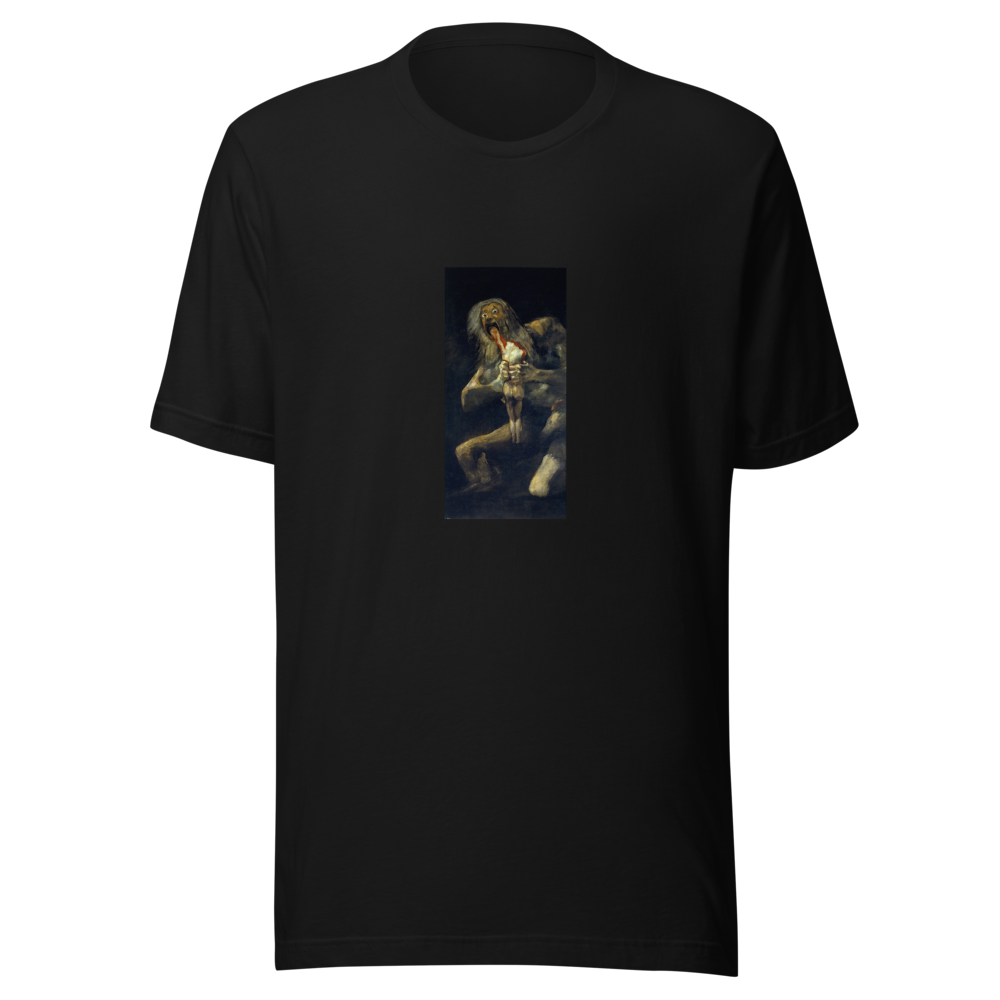
Saturn Devouring His Son
Inspired by the most unsettling mural canvas of the Pinturas Negras (1819–1823) by Francisco de Goya at the Quinta del Sordo. Meticulously restored at 300 DPI, honoring the textures and fissures of the original plaster prior to the censorship of 1874.
- Official garment: Bella + Canvas 3001 Unisex Black (S to 2XL)
- 100% high-durability combed and ring-spun cotton
- Digital screen printing in high chromatic density (native 300 DPI)
- Processing and global insured tracked shipping via Stripe
📏 Size Guide — Bella + Canvas 3001 (cm / inches)
| Size | Chest width | Length |
|---|---|---|
| S | 46 cm / 18.0" | 71 cm / 28.0" |
| M | 51 cm / 20.0" | 74 cm / 29.0" |
| L | 56 cm / 22.0" | 76 cm / 30.0" |
| XL | 61 cm / 24.0" | 79 cm / 31.0" |
| 2XL | 66 cm / 26.0" | 81 cm / 32.0" |
Garment measurements, laid flat. If you are between two sizes, choose the larger one.
Forensic Dossier: The Plaster Censorship of 1874
Francisco de Goya never titled this work. The name by which it terrifies the world today was posthumously recorded in 1828 by the painter Antonio Brugada. Goya did not paint it for the Paris Salon nor for any sacred altar: he rendered it with savage fury upon the plaster walls of the dining room in his country estate, the Quinta del Sordo, dwelling within it in absolute isolation.
In 1874, prior to the stripping of the plaster ordered by banker Émile d'Erlanger, French photographer Jean Laurent captured the sole visual record of the virgin painting. These plates reveal that Saturn possessed a grotesque, rigid erection between his thighs: the feral communion of cannibalism and vital instinct. Restorer Salvador Martínez Cubells discreetly scraped and repainted the pelvis during its transfer to canvas to render it palatable to bourgeois morality.
Furthermore, the anatomical examination of the victim confirms this is no mythological infant, but the fully formed body of a young adult: the somber metaphor of Fernando VII devouring Spain's own liberal sons.
Download the Complete Collectible Dossier (PDF)
Access the wet-collodion plate photographs by Jean Laurent (1874) and the detailed 2-page forensic report compiled by Marcus Scholar.